Fanola Toner Guide: Which Toner Is Which, and Which Needs a Test

Fanola's toners are mixed with a developer. The two covered here are No Yellow Color Toner, ammonia-based, mixed 1:2 with Violet Peroxyde, and Glow & Glossy Toner, ammonia-free, mixed 1:1 with Violet Peroxide 5 Vol. Both contain oxidation dye precursors, so plan a skin test. No Yellow shampoo, mask and foam deposit violet dye without developer.
That split matters more than the names on the bottles. If you only want to keep brassiness down between colour appointments, the No Yellow care products do that job, and how purple shampoo works explains the colour-wheel idea behind all of them. If you want to change the tone of freshly lightened hair, you need a mixed toner such as the two covered here, and that is a different kind of product with different precautions.
What counts as a Fanola toner?
"Toner" is a salon word, not a legal category. The UK and EU cosmetics rules only sort hair dyes into oxidative (dye that forms inside the hair when it is mixed with a peroxide developer) and non-oxidative (ready-made dye that needs no developer). That legal split is the useful one here, because it decides how you use a product and what safety steps apply.
On that basis, the products in this guide split into two mixed toners and three toning care products:
- Oxidative, mixed with developer: No Yellow Color Toner and Glow & Glossy Toner.
- Direct dye, no developer: No Yellow Shampoo, No Yellow Mask, and the No Yellow mousse conditioner, which is sold on this site as No Yellow Incredible Foam. Fanola's page and our listing carry the same barcode, so they are the same product under two names.
This is not Fanola's full list. Fanola's Violet Peroxyde pages also name "Fanola Toner" at 1:2, and our Fanola Color listing sells Toner - Silver and Toner - Natural shades; this guide does not cover them. Fanola's No Yellow bi-phase conditioner and thermo-protective cream, and the Wonder No Yellow shampoo and mask, also carry Acid Violet 43.

How do the Fanola toning products compare?
The dye type and directions are from Fanola's own product pages; the skin-test column is our reading of the UK cosmetics rules, because Fanola's pages print no test. Where Fanola prints nothing, the table says so rather than filling the gap.
| Product | Dye type | How Fanola says to use it | Skin test? |
|---|---|---|---|
| Fanola No Yellow Color Toner | Oxidative, with ammonia; ingredient list includes toluene-2,5-diamine sulfate (PTD) | Mix 1:2 with Violet Peroxyde; Fanola does not say which strength, so follow the leaflet. No processing time is published: follow the pack leaflet | Yes, as for any oxidative colour |
| Fanola Glow & Glossy Toner | Oxidative demi-permanent, ammonia-free (ethanolamine), with oxidation dye precursors | Mix 1:1 with Violet Peroxide 5 Vol; 10 to 30 minutes; lasts up to 15 to 20 washes | Yes: ammonia-free does not mean precursor-free |
| Fanola No Yellow Incredible Foam (No Yellow mousse conditioner) | Direct dye (Acid Violet 43), no developer | Shake; after shampoo, on towel-dried lengths and ends; 3 to 5 minutes; rinse well | Fanola's page prints no skin test; follow the pack |
| Fanola No Yellow Shampoo | Direct dye (Acid Violet 43), no developer | Gloves on; wet hair; massage, leave "a few minutes", lather and rinse | Fanola's page prints no skin test; follow the pack |
| Fanola No Yellow Mask | Direct dye (Acid Violet 43), no developer | Disposable gloves; after the No Yellow shampoo, on towel-dried lengths and ends; 3 to 5 minutes; rinse | Fanola's page prints no skin test; follow the pack |
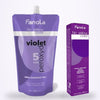
What is No Yellow Color Toner?
It is an ammonia-based colour. Fanola's own page describes it as colour that lets the hairdresser carry out professional technical services, available in 8 shades, for blonde, bleached, highlighted and grey hair. Its ingredient list includes ammonia and several oxidation dye precursors, among them toluene-2,5-diamine sulfate (PTD), a close relative of PPD. Our No Yellow Color Toner listing files it under permanent colour.
The mixing ratio is printed on Fanola's Violet Peroxyde developer pages (the same line appears on the 5 vol and the 25 vol page), not on the toner page: "No Yellow Color Toner: Violet Peroxyde 1:2", meaning one part toner to two parts developer. Fanola does not publish a processing time for it anywhere we could find. Follow the leaflet in the pack, and watch the colour develop rather than relying on a clock. Fanola also prints no hydrogen peroxide percentage for "5 vol", so we have not converted it to one.
Fanola's page for this toner does not claim it lifts hair. Treat it as a tone change at the level you have already reached, not as a way to get lighter. It is still an ammonia colour mixed with peroxide, and Fanola publishes no lift figure either way, so do not assume it cannot lighten at all.
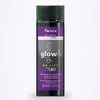
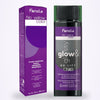
What is Glow & Glossy Toner?
Fanola describes Glow & Glossy Toner as a demi-permanent colour in an oil base, without ammonia. Of the two toners here, it is the one with a published processing time: mix 1:1 with Violet Peroxide 5 Vol, process for 10 to 30 minutes, and expect results lasting up to 15 to 20 washes. Fanola does not say which end of that range suits which hair. One manufacturer's patent says porous, damaged ends colour more intensely, and its own small test on bleached hair leaned that way, so it is sensible to check early on very light, porous hair. That is our suggestion, not a Fanola instruction.
Ammonia-free is not the same as gentle on skin. In place of ammonia it uses ethanolamine, and the Toner page lists oxidation dye precursors, one of them a p-phenylenediamine derivative by name. Fanola's pages for four other Glow & Glossy shade families list PTD as well.
Fanola credits the range with "No Lift technology" that tones without lightening natural pigment. That is Fanola's description. We found no lift measurement for Glow & Glossy. For one alkaline demi from another brand, the manufacturer's own patent tests measured some lift on medium-brown hair samples (not on pre-lightened hair), so "less lift" is a safer working assumption than "none".
The developers are not interchangeable. Both toners use Fanola's violet developer, at different ratios: 1:2 for No Yellow Color Toner (strength left to the leaflet) and 1:1 with 5 Vol for Glow & Glossy. Using one toner's ratio for the other changes how diluted the colour is on the head.
Is there a colour chart for the toner shades?
There is a Glow & Glossy Colour Chart; we have not confirmed which shades, including which T-codes, it shows. On Fanola's site the Glow & Glossy toner shades are T.02, T.11, T.12, T.21, T.41, T.Clear and T.Rose. The "T" marks a toner shade within the wider Glow & Glossy line, which also has numbered shades such as 8.1 or 10.3. Fanola publishes no written tone description for each T-code in the pages we checked, so a swatch, on the chart or the pack, is the honest way to choose.
For the No Yellow side there is a No Yellow Color chart with 22 colours. Our listing describes it as the chart for the No Yellow Color line; we have not confirmed which of its swatches are toner shades.

Which Fanola toning products need a skin test?
Both mixed toners. The line to draw is developer-mixed oxidative colour versus direct dye, not "permanent versus demi". UK cosmetics law requires products containing PPD or PTD to carry the "Hair colourants can cause severe allergic reactions" warning, and No Yellow Color Toner lists PTD. Demi-permanents use the same families of dye precursors as permanents, which is why Glow & Glossy belongs on the same side of the line.
Fanola's pages print no test method. Use the one in the pack leaflet. Some context on how much the test can tell you:
- In one European general-population study, 0.8% of adults tested positive to PPD on a clinical patch test. Most people are not allergic, but you cannot tell in advance who is.
- No UK statute we found requires a 48-hour test. Any duty would most likely come indirectly, for example from the manufacturer's directions or from general negligence law; we found no ruling, and this is not legal advice.
- The EU's scientific committee on consumer safety "cannot, at this stage, endorse" the self-test as an allergy alert, partly because it may miss some allergic people. In industry studies it picked up most people already known to be allergic, but a clear result does not rule an allergy out.
The direct-dye products are not "allergy-free" either. A 2018 survey found that the dyes in direct-dye hair products differ from oxidative ones and are not covered by standard clinical patch-test series. That Fanola's pages print no skin test for them is not, on its own, evidence of low risk.
"No ammonia" and "PPD-free" are not allergy claims. PTD, the substitute often used in place of PPD, often cross-reacts with PPD allergy. If you have ever reacted to hair colour, do not use either of these toners without advice.
Do the toners go on wet or dry hair?
Fanola does not say for either toner. Neither toner page gives a hair state, and the searches we have on record found no Fanola leaflet online that does (we have not checked a pack insert). Other brands disagree with each other: some say dry, some towel-dried, some either. The two brands we found that describe an effect, Wella and Matrix, say water in the hair gives a softer, lighter or less durable result, though Wella pairs towel-dried hair with a shorter time, so water alone is not isolated. Those are manufacturer statements, though, and no study we found compares the same toner on wet and dry hair. So the instruction to follow is the one in your pack.
The care products are clearer. Fanola says the shampoo goes on wet hair, and the mask and foam go on towel-dried lengths and ends after shampooing. Fanola tells you to wear gloves for the shampoo and mask. Keep these violet products away from light towels and fabrics as well.
The foam is a rinse-off product on Fanola's directions. Fanola's page for the No Yellow mousse conditioner says: after shampoo, apply to towel-dried lengths and ends, leave 3 to 5 minutes, then rinse thoroughly, and shake before use. Fanola also says it is particularly suited to fine hair. That is how to use the No Yellow Incredible Foam.
Can a purple shampoo do a toner's job?
Only for upkeep. Fanola's No Yellow Shampoo, Mask and foam carry Acid Violet 43, a ready-made violet dye that sits on the hair. With no developer in the mix, there is nothing in them that can lighten hair or change its level. They counter yellow tones; they do not change the hair's underlying level. For the routine itself, see how to use purple shampoo, and for what anti-yellow formulas really do, non-yellowing shampoo explained.
A mixed toner is a colour service. Toning straight after bleach, correcting uneven or banded lift, and toning chemically damaged or previously henna'd hair are salon jobs. If the hair is not yet light enough, no toner or purple shampoo will fix that. It needs a colourist, not more pigment.
Which one should you choose?
- Brassiness creeping back between appointments: No Yellow Shampoo, with the mask or foam as the second step. If you are choosing between the two shampoo lines, No Yellow versus Wonder No Yellow sets them side by side.
- A full tone change on pre-lightened hair, with published timings: Glow & Glossy Toner, applied by someone used to mixing oxidative colour.
- Working inside the No Yellow colour system: No Yellow Color Toner with Violet Peroxyde at 1:2, timed by eye and by the leaflet.
Common questions
How long do you leave Fanola toner on?
It depends which toner. Fanola gives Glow & Glossy Toner a processing time of 10 to 30 minutes, mixed 1:1 with Violet Peroxide 5 Vol; on very light, porous hair, check towards the start of that range (our suggestion, not a Fanola instruction). For No Yellow Color Toner, Fanola publishes no time at all, so follow the leaflet in the pack and watch the colour develop.
What developer do you use with Fanola toner?
Both use Fanola's Violet Peroxyde developer. Its Violet Peroxyde developer pages (5 vol and 25 vol) give a ratio of 1:2 for No Yellow Color Toner, meaning one part toner to two parts developer. The Glow & Glossy page says to mix 1:1 with Violet Peroxide 5 Vol. For No Yellow Color Toner Fanola does not say which strength, so follow the pack leaflet. Fanola prints no peroxide percentage for 5 vol.
How do you use Fanola No Yellow toner?
No Yellow Color Toner is mixed 1:2 with Violet Peroxyde (strength per the pack leaflet) and applied as a colour service, after a skin test. Fanola publishes no processing time, so the pack leaflet is the guide. If you mean the No Yellow foam, that is used after shampoo on towel-dried lengths, left 3 to 5 minutes and rinsed.
Is Fanola Glow & Glossy permanent?
No. Fanola calls Glow & Glossy a demi-permanent colour in an oil base, without ammonia, and says results last up to 15 to 20 washes. It is still an oxidative colour: it is mixed with developer and its ingredient list includes oxidation dye precursors, so it needs the same skin-test care as a permanent shade.
Does Fanola toner lighten hair?
Fanola does not sell either toner as a lightener. It describes Glow & Glossy as toning without lightening natural pigment, though no lift test for it was found. The No Yellow Color Toner page makes no claim about lift either way. The No Yellow shampoo, mask and foam contain no developer, so they cannot lighten hair at all.
The Fanola toners and toning care on this site
The two developer-mixed toners covered here, for a colour service, and violet direct-dye care for keeping the result between appointments.
No Yellow Color Toner: ammonia-based, 1:2 with Violet Peroxyde →
Glow & Glossy Toner: ammonia-free demi, 1:1 with 5 Vol →
No Yellow Incredible Foam: rinse-off after shampoo →
More on Fanola toners and toning
Fanola No Yellow Toner: How to Mix It, Patch Test and Lighteners →
Glossy Toner or Colour Mask? Fanola Glow & Glossy vs Color Mask →
Do You Need a Patch Test for Toner? What Fanola's Toners Contain →
Do You Put Toner on Wet or Dry Hair? What the Brands Actually Say →
Which Developer Strength for Toning? What Fanola Actually Prints →
Always follow the instructions supplied with the product. Carry out the allergy test described in the pack leaflet before any oxidative colour or toner, and if you are unsure about a colour service, speak to a professional colourist.
-
Posted in
Blonde, Glow & Glossy, No Yellow, Toner, Toning