Which Developer Strength for Toning? What Fanola Actually Prints

Which developer strength for toning depends on the Fanola toner in the bowl. Fanola's page names Violet Peroxide 5 Vol, mixed 1:1, for Glow & Glossy Toner. For No Yellow Color Toner it prints a 1:2 ratio with Violet Peroxide but no strength on that line, so the pack leaflet decides. Fanola prints no percentage for 5 Vol.
That answer is short because it only uses what Fanola itself prints. Everything below is either a line from Fanola's own product pages, simple bowl arithmetic labelled as ours, or a figure from another maker that we name. For what toning products do and do not do in the first place, how purple shampoo works covers the colour theory behind the violet pigment.
What developer does Fanola say to use with its toners?
Fanola's directions name its violet-tinted developer, not a plain peroxide. For No Yellow Color Toner, the usage line sits on the Violet Peroxide pages rather than the toner page, which is why it is easy to miss. Glow & Glossy prints its own. Fanola does not label which side of the ratio is which. We read it colour first, developer second, which is the usual trade convention and matches our Fanola Color Peroxide 1000ml listing; check it against the leaflet in the pack:
| Fanola product | Developer Fanola names | Ratio as printed | Developer share of the bowl (our arithmetic) |
|---|---|---|---|
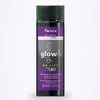
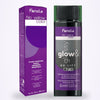
| Fanola Glow & Glossy Toner | Violet Peroxide 5 Vol, named on the toner's own page | 1:1 | One half |
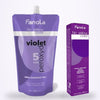
| Fanola Toner and No Yellow Color Toner (as printed) | Violet Peroxide; the line appears word for word on both the 5 Vol and 25 Vol pages | 1:2 | Two thirds |
| Fanola Color and No Yellow Color | Violet Peroxide | 1:1.5 | Three fifths |
| Fanola No Yellow Color Bleach | Violet Peroxide | 1:2 | Two thirds |
Fanola's developer page also lists 'Fanola Toner' at 1:2 without saying which product that is. Glow & Glossy's own page says 1:1, so follow the toner's own page and the leaflet.
Two things follow. For Fanola Glow & Glossy the answer is complete: 5 Vol, 1:1, and Fanola gives a processing time of 10 to 30 minutes. For Fanola No Yellow Color Toner the ratio is printed but the strength is not pinned to it, because the same sentence sits on both Violet Peroxide pages. Fanola's toner page itself gives no processing time either. The leaflet in the box fills both gaps.
A note on our own listing. Our No Yellow Color Toner listing describes it as lifting, which Fanola's page does not say. Where the two disagree, this article follows Fanola's own pages, and the leaflet in the pack overrides both.
Why won't we turn 5 Vol into a percentage?
Because Fanola does not print one, and the conversion is looser than it looks. "Volume" is the volume of oxygen gas one volume of the solution can release. The familiar trade ladder is a convention, not an exact physical rule:
| Developer volume | Hydrogen peroxide %, conventional and approximate |
|---|---|
| 5 Vol (Fanola Violet Peroxide) | Not printed by Fanola, so not stated here |
| 10 Vol developer | About 3% |
| 20 Vol developer | About 6% |
| 25 Vol (Fanola Violet Peroxide) | Not printed by Fanola, so not stated here |
| 30 Vol developer | About 9% |
| 40 Vol developer | About 12%. UK and EU law caps hair products at 12% (40 volumes) in the ready-to-use preparation |
The 10/20/30/40 to 3/6/9/12 pairing is the industry's standard shorthand, and our own Fanola Color Peroxide listing prints the same four pairs. The physical ratio drifts slightly as strength rises, which is why every row says "about". Fanola's 5 Vol and 25 Vol sit off that ladder, and dividing by three to get a number would be our guess dressed up as Fanola's figure.
What does the mixing ratio do to the strength in the bowl?
The ratio dilutes the developer, so the bowl starts weaker than the bottle. Assuming the toner cream contains no peroxide of its own, the starting strength is the bottle's strength multiplied by the developer's share of the mix. At 1:1 that share is a half; at 1:2 it is two thirds.
A worked example with a conventional figure, from the developer chemistry we rely on: a 6% developer mixed 1:1 starts at about 3% in the bowl (measured by weight, assuming the cream holds no peroxide). For Fanola's 5 Vol we can only give the proportion. Glow & Glossy at 1:1 starts at half the bottle's strength; No Yellow Color Toner at 1:2 starts at two thirds of it, about a third more than 1:1 from the same bottle.
The ratio is part of the strength. More developer in the bowl means a stronger starting mix, not a weaker one. Fanola's page does not say whether its parts are by weight or by volume. The arithmetic above is by weight, so weigh both parts on scales and do it the same way every time.
These are starting figures only. No study in the research we rely on measured how long peroxide lasts once mixed into a colour cream.

Does "20 Vol gives two levels of lift" hold for every brand?
No. A lift figure belongs to one maker's system, not to peroxide. People believe the rule because brands print it: our own Fanola Color Peroxide listing says 20 Vol gives up to 2 levels. Other makers' figures differ at the same strength, though. Wella's Koleston Perfect fact sheet gives 6% "1 level of lift", Schwarzkopf's IGORA ROYAL manual gives 6% "Lifting 1–2 levels", and L'Oréal gives 20-vol "lifts up to 2 levels".
No independent study has measured lift across a matched 3/6/9/12% series. The peroxide is also not the only lever. The alkaliser matters: Fanola's own ingredient lists show ammonia in No Yellow Color Toner and ethanolamine, not ammonia, in Glow & Glossy. What to do: take the strength and the ratio from the system you are actually mixing, and never borrow a lift figure from another brand.
What goes wrong when the developer is stronger than directed?
The honest answer is that the effect is poorly measured. One manufacturer's patent says lower peroxide "may be associated with reduced damage to hair", but that is a design aim, not an independent trial. The only patent damage data we have for one brand's demi toner (Wella Color Touch) used with a stronger developer than specified also raised the alkaliser, so it cannot show what the stronger peroxide alone did to the hair. It is one manufacturer's patent, not an independent trial.
Fanola's Violet Peroxide pages also list "controlled lightening action" among the results. Glow & Glossy's page, by contrast, says the toner neutralises unwanted tones without lightening natural pigment. Fanola makes that no-lift claim for the toner system, at its stated 5 Vol and 1:1, not for the developer on its own. Swapping in a stronger bottle leaves the conditions Fanola describes.
Both Fanola toners are oxidation colours. Fanola's ingredient lists show oxidation-dye precursors in each, so carry out the allergy alert test exactly as the pack leaflet describes. Fanola's web pages print no test method. Wear gloves to mix and apply, and strand-test before a full head.
Mixing developer with a professional toner is a salon service. Banded or heavily processed hair, and big colour corrections, belong with a colourist. Never bleach at home to fix a tone.

Common questions
Can you use toner without developer?
Not a Fanola oxidation toner. Fanola gives a developer ratio for both No Yellow Color Toner and Glow & Glossy, and both list oxidation-dye precursors that are sold to be mixed with developer. No verified study has tested them without it. For toning with no developer, see how to use purple shampoo.
10 Vol or 20 Vol for toning?
For Fanola's toners, neither is what Fanola names. Its pages pair Glow & Glossy with Violet Peroxide 5 Vol at 1:1, and give No Yellow Color Toner a 1:2 ratio with Violet Peroxide. Our Color Peroxide listing calls 10 Vol suitable for subtle toning, but that is listing copy. Follow Fanola's pairing and the leaflet.
When is the 3.5 Vol activator used?
Neither Fanola toner direction we checked mentions the Fanola Color Cream Activator 3.5 Vol, and our 300ml listing for it prints no percentage. Being the lowest number on the shelf does not make it the right partner for a toner. Use it only where the instructions for the colour you are mixing name it.
Which developer to use with toner for orange hair?
Fanola describes its toners and Violet Peroxide as neutralising yellow; neither page claims to correct orange. Fanola names a developer and ratio for each toner, and neither page suggests changing the strength to deal with orange. If orange shows through, that is a colourist's call, not a stronger bottle. For keeping orange tones in check between services, see blue shampoo for orange tones.
Does a toner lighten bleached hair?
Fanola's Glow & Glossy page says its No Lift technology neutralises unwanted tones without lightening natural pigment. Fanola makes no lift claim on its No Yellow Color Toner page. A toning shampoo is a different thing: its dyes are pre-formed direct dyes, and none of the purple shampoo labels in the research we rely on lists an oxidant such as hydrogen peroxide. If the hair is not light enough yet, that is a lightening question for a colourist.
The Fanola toners and developers named above
At the time of writing: Violet Peroxide 5 Vol 1000ml £4.22, No Yellow Color Toner £5.50, Glow & Glossy £8.99. Prices change. Strength, ratio and timing always come from the pack.
Fanola Color Violet Peroxide 5 Vol 1000ml →
Every peroxide and developer we stock →
The colour toning collection →
More on Fanola toners and toning
Fanola No Yellow Toner: How to Mix It, Patch Test and Lighteners →
Fanola Toner Guide: Which Toner Is Which, and Which Needs a Test →
How Soon After Bleaching Can You Use a Toning Shampoo or Toner? →
Always follow the instructions supplied with the product. Carry out the allergy test the manufacturer specifies, strand-test before a full application, and if you are unsure about a colour service, speak to a professional colourist.
-
Posted in
Developer, How to, Professional colour, The Fanola range and the salon, Toning