Blue Shampoo: How Blue Pigment Kills Orange Tones

A no orange shampoo, also called a blue or anti-orange shampoo, is a shampoo with blue pigment that neutralises unwanted orange tones, and Fanola's version, Wonder No Orange, is made for light brown and dark blonde hair. It adds colour over the warmth rather than taking anything out, and its published ingredient list contains no peroxide or other oxidiser, so it is not a lightener.
What is a no orange shampoo?
A no orange shampoo is a cleansing shampoo with dye added. Fanola's English product page calls Wonder No Orange a "shampoo with blue pigment" that "neutralizes undesired orange reflections", and gives it the subtitle "Anti-orange shampoo softness and brightness".
There is no developer (the peroxide that makes bleach and permanent colour work) and no mixing step. Fanola's Italian page lists the shampoo's ingredients, and none of them is hydrogen peroxide, a persulfate or any other oxidiser. The directions are a 1 to 5 minute application on wet hair, and the stated result is "Neutralizza i toni aranciati" (it neutralises orange tones), with no claim to lighten.
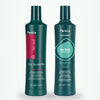
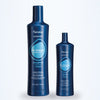
On this site every Fanola anti-orange product is from the Wonder No Orange line. The site has no classic (non-Wonder) No Orange shampoo or mask. The Wonder No Orange collection holds six products: the shampoo in 350ml and 1000ml, the mask in 350ml and 1000ml, a Shampoo + Mask 1000ml double pack, and a separate 1L bottle pump. Fanola No Orange versus Wonder No Orange explains how the two lines differ.

Is an "orange shampoo" the same as an anti-orange shampoo?
On this site, yes. The Wonder No Orange Shampoo 1000ml listing calls it "this orange shampoo", but what it does is cancel orange, not add it. Fanola's English page ties the name to the pigment: the shampoo is a "shampoo with blue pigment" that "neutralizes undesired orange reflections".
If you actually want more copper, that is a different product. The Fanola Color Mask 200ml comes in a Copper Flow shade, which its listing describes as "warm, fiery tones with a reflective glow". It is a temporary colour treatment that the listing says lasts "up to 8-10 washes".
Why does lightened hair go orange?
Goldwell's colour education glossary says: "When lightening hair, a residual warmth in tone always occurs." Its definition of natural contributing pigments adds that as hair is lightened, "In darker levels, orange will appear: in lighter levels, gold (yellow-orange) will appear."
Wella's professional-store blog is more specific: "orange tones usually appear in level 5, 6 or 7 hair – essentially, anything from your dark blondes to dark brunettes and redheads", while yellow reflects are common at levels 7, 8, 9 and 10, "a dark to very light blonde". So orange shows at mid depths and yellow at the lighter end, with level 7 able to show either.
Level scales are not identical from maker to maker. A cosmetology training module (ContinuingCosmetology.com) uses 10 levels, 1 for black to 10 for the lightest blond, and notes that the names given to the levels "can vary among product companies". Goldwell's own system runs from 2 to 10.
Wella lists three common causes of orange, in this order:
- A red colour has faded.
- The target shade was a warm dark blonde or brunette, but "the warmth has become too dominant".
- Dark hair was lifted to level 5, 6 or 7, and "Orange is the undertone that lives at that level." Wella's next step here is toning.
A blue shampoo will not turn orange hair blonde. Nothing in its listed formula lightens. The worked examples on Wella's blog show two different routes. In the one where the goal was a lighter, creamy blonde, the stylist first lifted the orange out with BlondorPlex and 6% (20 volume) developer. In the dark blonde and dark brown examples, the orange was corrected by depositing tone, with no extra lift. A blue shampoo can only ever do the second kind of job.
What does blue shampoo do to orange hair?
Blue shampoo leaves some blue dye on the hair, and the orange looks muted and closer to neutral. Nothing is taken out. Purple shampoo works the same way on yellow blonde: see how purple shampoo works.
Hairdressing education explains this with the colour wheel, matching each unwanted tone to the colour opposite it. Goldwell's glossary prescribes "ash-blue for unwanted orange tones". The wheel itself goes back to Newton's colour circle, which Britannica describes as "still widely used for purposes of colour design". Britannica also notes that "Blue pigment absorbs primarily yellow, orange, and red light"; applied to hair (our step, not Britannica's), blue dye soaks up some of the orange the hair would otherwise reflect.
Goldwell's education manual, All About Color, prints the result as an equation: "ORANGE + BLUE = BROWN". Not lighter, but quieter and browner.
"Kills orange" means hides it, not removes it. The ContinuingCosmetology.com module groups colour shampoos with temporary colour. It describes temporary colour as non-oxidative, needing no developer, only coating the hair and "easily shampooed away", with "No chemical change in the hair". Since the hair itself is not chemically changed, the warm pigment underneath is still there when the blue washes out.
Fanola's 1000ml listing frames the shampoo two ways: after a colour service, to refine tones, or "as a weekly treatment to preserve cool hues"; its directions say to use it once or twice a week. It also says the shampoo corrects brassiness.
Expect the hair to look a little deeper as well as cooler. Goldwell's equation ends in brown, not blonde, and the same training module states as a basic colour rule that blue "can provide depth and darken any color". That is a rule of thumb, not a measurement of any shampoo.
What dye is actually in a blue shampoo?
Fanola's Italian product page for Wonder No Orange Shampoo lists two dyes: CI 42090 (FD&C Blue 1), a blue, and Acid Violet 43, a violet. The page shows the same ingredient list for the 350ml and 1000ml sizes. The listings on this site print no ingredient list. Fanola gives no proportions.
Acid Violet 43 is a familiar toning dye. ÖKO-TEST's October 2025 test of 20 silver shampoos from German shops found it in every one. A 2025 review of hair dyes (de Souza et al., ACS Omega) classes Acid Violet 43 as an acid temporary dye, held by an ionic (charge) attraction to the outer layer of the hair rather than a permanent chemical bond. The review does not cover CI 42090.
Goldwell's glossary matches a neutralising shade to each warm tone: "ash-blue for unwanted orange tones, pearl (blue-violet) for unwanted gold (yellow-orange), violet for unwanted yellow." In practice, match the bottle to what you see: yellow wants violet, orange wants blue.
| Unwanted tone | Neutralising shade | Fanola shampoo on this site | Where it usually shows |
|---|---|---|---|
| Yellow | Violet | Fanola No Yellow Shampoo (its listing: "Enriched with powerful violet pigments") | Levels 7 to 10, dark to very light blonde (Wella) |
| Orange | Ash-blue | Fanola Wonder No Orange Shampoo ("shampoo with blue pigment") | Levels 5, 6 or 7 (Wella); light brown and dark blonde hair, per the Wonder No Orange listing |
| Red | Green (colour-wheel opposite) | Fanola No Red Shampoo. Its listing mentions green pigments, but its INCI names HC Blue No. 15, Basic Brown 17, Basic Yellow 87 and Basic Red 76, and no green dye | Brown and chestnut hair, per the No Red listing |
| Yellow-orange (gold) | Pearl (blue-violet) | Not covered in this guide | Goldwell: "in lighter levels, gold (yellow-orange) will appear" |
Red is a different job, covered in green shampoo for red tones. For the violet side, see what No Yellow shampoo is.
Which Fanola blue product should you use, and for how long?
The shampoo's listings say to leave it 1–5 minutes on wet hair: twice a week on the 350ml listing, once or twice a week on the 1000ml. The mask's listings say 3–5 minutes on damp hair.
| Product | Listed price | What its listing says about timing |
|---|---|---|
| Fanola Wonder No Orange Shampoo 350ml | £7.41 | Massage into wet hair, let sit 1–5 minutes, rinse thoroughly. "Use twice a week for best results." |
| Fanola Wonder No Orange Shampoo 1000ml | £14.82 | Lather and allow to sit 1–5 minutes "depending on the intensity of toning desired"; use once or twice a week |
| Fanola Wonder No Orange Mask 350ml | £9.70 | On towel-dried damp hair, 3–5 minutes "depending on the level of toning needed", then rinse. No frequency given on this listing. |
| Fanola Wonder No Orange Mask 1000ml | £18.13 | On damp hair, 3–5 minutes, "use once a week"; the listing warns the mask "is potent, so use sparingly" |
| Fanola Wonder No Orange Shampoo + Mask 1000ml (double pack) | £24.99 (a bundle price) | The 1000ml shampoo and 1000ml mask together; follow each product's own instructions |
These are the listed prices at the time of writing, and they will change. The smallest way into the line is the Fanola Wonder No Orange Shampoo 350ml. The 350ml listing says it is ideal for blonde and light brown hair, whether natural or coloured. Start at the short end of the published time range, rinse, look at the result once the hair is dry, and leave it longer next time if you need to. When the mask beats the shampoo covers the same choice for the No Yellow line.

Wear gloves. Fanola's own instructions for Wonder No Orange shampoo say to apply it "wearing the appropriate gloves". Fanola does not give a reason, so simply follow the instruction.
Fanola also says the shampoo "does not stain the scalp". That claim covers the scalp only.
What can't a blue shampoo do?
A no orange shampoo is not a lightener. Its listed ingredients contain no oxidiser, so it cannot lift hair that was under-lifted. Nor is it the same thing as a salon toner. Wella's Koleston Perfect pastel toning shades, for example, are "Always mixed 1:2 with 1.9% Welloxon Perfect Pastel Developer", and Wella requires the hair to be evenly pre-lightened (or naturally that light) to half a level lighter than the result you want.
Do not expect it to even out patchy colour. Goldwell's glossary calls it "grabbing" when colour is "absorbed more readily in porous or damaged areas of the hair", so a shampoo that goes on everywhere can leave more blue on porous sections than on the rest.
It cannot repair damage either. In a lab study of bleached human hair fibres (Grosvenor et al., International Journal of Cosmetic Science, 2018), alkaline peroxide-persulphate bleaching reached the cortex, the inside of the hair, and oxidised its proteins. A colour shampoo that, by the training module's definition, makes "No chemical change in the hair" cannot undo that. The shampoo base still washes the hair, and the 1000ml listing says to follow with "a conditioner or treatment for enhanced hydration".
Common questions
Is there a Fanola blue shampoo?
Yes: Fanola Wonder No Orange Shampoo, in 350ml and 1000ml, with a matching mask.
How often should I use a no orange shampoo?
Follow the pack. The Fanola Wonder No Orange Shampoo 350ml listing says to use it twice a week, and the 1000ml listing says once or twice a week. The 1000ml mask listing says once a week.
Will blue shampoo affect grey or white hair?
It can. Fanola says Wonder No Orange is "ideal for a subtle Icy Blue effect on white hair", so on white hair a cool cast is intended. A Procter & Gamble patent application (US20170273883A1) notes that when grey or white hair is coloured with blue or violet direct dyes to correct yellowing, it generally ends up "too blue or violet than it is needed". If you do not want a blue tint, strand-test first, keep the contact time short and check the result once it is dry.
Will it stain my hands?
Fanola does not say. Its directions tell you to wear gloves, and it says the shampoo "does not stain the scalp", which covers the scalp only. Follow the glove instruction.
Is the 1000ml worth it over the 350ml?
On price per millilitre, yes. At the listed prices, the 350ml works out at roughly £2.12 per 100ml and the 1000ml at about £1.48, about 30% less per millilitre. The 1000ml listing is written for hairdressers and salons.
Fanola Wonder No Orange on this site
If you are fighting orange tones, this is the Fanola anti-orange line we sell.
The full Wonder No Orange collection →
Wonder No Orange Shampoo + Mask 1000ml double pack →
Next: Fanola No Orange vs Wonder No Orange →
Always follow the instructions supplied with the product. Patch-test where the manufacturer requires it, and if you are unsure about a colour service, speak to a professional colourist.
-
Posted in
Blue shampoo, Blue shampoo and orange tones, Colour theory, Orange tones, Toning