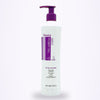
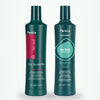
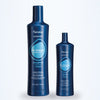
Fanola No Orange vs Wonder No Orange

Fanola No Orange and Fanola Wonder No Orange are both sold as blue-pigment shampoos for unwanted orange and copper tones, the ingredient lists we found for each declare the same two dyes, a violet and a blue, and nothing we found from Fanola says either one tones harder. What changed is the care formula, and only Wonder is listed on this site, so if you are buying here, Wonder is the one to get.

Fanola No Orange vs Wonder No Orange: what is the difference?
The published difference is the care formula, not the toning. Fanola's page features guar gum and seaweed extract for Wonder No Orange, though its printed ingredient list shows a guar derivative and no seaweed extract we could see. Cosmetify's copy for the classic names coconut oil and Tiaré flower. Both are described with one to five minutes on wet hair.
The nearest Fanola comparison is on the violet range: its Wonder No Yellow page says the Wonder formula "delivers the same neutralization performance as the classic No Yellow Shampoo, while ensuring optimal softness, enhanced luminosity, and uniform tonal results." We found no such comparison on Fanola's Wonder No Orange page.
Usage differs slightly: Cosmetify's copy for the classic says once a week, or as and when desired, while the Wonder No Orange Shampoo 350ml listing says twice a week and the 1000ml listing says once or twice.
The same question is answered for the violet line in the No Yellow comparison, and the colour logic behind both is in blue shampoo for orange tones.
| Point of comparison | Fanola No Orange (classic) | Fanola Wonder No Orange |
|---|---|---|
| Listed on fanola.hair | No shampoo or mask. The only non-Wonder "No Orange" item is a £1.00 pump accessory. | Yes: shampoo, mask, a shampoo-plus-mask bundle and a pump. |
| Sizes | 350ml and 1000ml (Cosmetify). | 350ml and 1000ml, in both the shampoo and the mask. |
| Who it is aimed at | Cosmetify: brunette, dark blonde and warm tones. | Fanola: light brown hair, natural or coloured. This site's 350ml listing: blonde and light brown. The 1000ml listing: light brown to dark blonde, dyed or undyed, including balayage and highlights. |
| Care ingredients named in the copy | Coconut oil and Tiaré flower. | Guar gum and seaweed extract. |
| Published leave-on time | One to five minutes. | 1–5 minutes, on Fanola's page and both shampoo listings here. |
| Published frequency | Once a week, or as and when desired. | Twice a week (350ml listing); once or twice a week (1000ml listing). |
| Declared colourant | Acid Violet 43 and CI 42090, a violet and a blue (2023 user-submitted record). | Acid Violet 43 and CI 42090 (FD&C Blue 1), on Fanola's Italian product page, whose barcode matches the 350ml sold here. Of this site's shampoo listings, only the 1000ml mentions "blue pigments". |
| Price on this site | Not sold here. | £7.41 for 350ml, £14.82 for 1000ml, at the time of writing. |
Classic: retailer Cosmetify's own product copy (checked 6 October 2026) and one user-submitted 2023 ingredient record. Wonder: Fanola's site and this site's listings, same day.
What do the ingredient lists show?
The only list we found for the classic is a 2023 user upload, not a Fanola or retailer listing. It shows Acid Violet 43 and CI 42090, a blue, and Fanola's own Italian page for Wonder No Orange shows the same pair, so this "blue shampoo" is really a violet-and-blue blend. Under the UK cosmetics regulation, ingredients are listed in descending order of weight, but anything under 1% may be listed in any order after the rest. The label doesn't show where that line falls, so a dye's position tells you it is there, not how much.
Why both dyes? Wella's education blog on orange hair says "a touch of blue pigment will cool and calm hair that is too warm, while a hint of violet is also helpful for yellow/orange strands, on a level 7." Fanola doesn't explain its own blend.
On the masks, the Wonder No Orange Mask 1000ml listing here mentions "Violet Pigments" but prints no ingredient list. For the Mask 350ml, Fanola lists Acid Violet 43 and CI 42090. Fanola says to always check the pack, so read the panel on the one you receive.
A "blue shampoo" is not always a blue dye. Lee Stafford's Ice White Toning Shampoo, for one, is sold on "blue pigments", but the only colourant in its printed list is Acid Violet 43, with nothing named blue. Fanola's own list for Wonder No Orange, and the classic No Orange record, both declare a blue (CI 42090) as well. The only way to tell is to read the list.
What do Fanola No Orange shampoo reviews and before-and-after photos show?
There are very few. On this site the 1000ml Wonder No Orange shampoo has one five-star review saying it makes orange tones "ashy", and the 1000ml mask has one two-star review calling it "very rich and softening" but saying it "did zero" to brassiness. Cosmetify's classic listing has none. Treat each as one head of hair.
That leaves your own result as the real test: start at the short end of Fanola's one to five minutes and add time on later washes only if the orange is still there.
Who is blue toning for, and who is it not for?
Fanola sells Wonder No Orange as a blue-pigment shampoo that neutralises unwanted orange reflections. A US continuing-education course on hair colour sets out levels from 1 (black) to 10 (lightest blonde). Wella's blog says orange tones usually appear at levels 5, 6 or 7, and yellow at 7 to 10, so a level 7 can show either.
Fanola aims Wonder No Orange at light brown hair, inside that orange band. Level names vary between manufacturers, so trust the colour you see. If what you see is pale yellow rather than orange, Wella points to violet instead; see how purple shampoo works and what No Yellow shampoo is.
A toning shampoo is not a lightener. Neither Fanola's Wonder No Orange list nor the classic record includes hydrogen peroxide or any other developer, and Fanola sells it as a shampoo with blue pigment. For heavy orange, Wella's blog recommends a professional colour formula with ash or pearl as the main tone: a job for a colourist.
Wear gloves: Fanola's directions for the shampoo say "appropriate gloves" and for the mask "disposable gloves", though the listings here leave it out.
Should you use the No Orange mask as well as the shampoo?
Add it if the shampoo alone leaves warmth, and go carefully. Both Wonder mask listings here ask for 3–5 minutes on damp, towel-dried hair, while Fanola's own directions say wet hair, lengths and ends, after the shampoo. The 1000ml listing says once a week and adds that the mask "is potent, so use sparingly for best results". For how a toning mask fits around a shampoo in the violet range, see the No Yellow mask guide.
If you still have a bottle of the classic, read its pack before using it alongside Wonder: Fanola gives no guidance on mixing the two generations on any page we checked.
Where can you buy Fanola No Orange in the UK?
Classic Fanola No Orange is not listed on this site; Wonder No Orange is. Retailer Cosmetify lists the classic in 350ml and 1000ml. Fanola's own site now lists only the Wonder No Orange line, a shampoo and a mask. The Fanola No Orange 1L Pump listed here says it screws onto the 1L bottle of Fanola No Orange or Wonder No Orange Shampoo.
The verdict
Buy Wonder. No test shows it beats the classic, but it is the only No Orange line Fanola lists on its own site and the one listed here, and Fanola says its Wonder No Yellow reformulation kept neutralising power while improving softness.
Start on the 350ml at home; move to the 1000ml behind the chair.
Common questions
Is Wonder No Orange stronger than the classic?
No published claim says so either way. On the violet range, Fanola says Wonder No Yellow matches the classic on neutralisation, and its softness, rinsing and combing gains come from "120 in-salon self-assessment tests after first use", with no method given.
Do you need gloves with Fanola No Orange?
Yes. Fanola's own directions for Wonder No Orange say to wear appropriate gloves. Fanola says it does not stain the scalp, though it gives no evidence for that and promises nothing for hands or nails.
Does No Orange darken grey hair?
Fanola doesn't say it darkens grey, but it does say the blue can show: its Italian page calls Wonder No Orange ideal for "un delicato effetto Icy Blue", a subtle icy-blue effect, on white hair. Fanola gives no white-hair timing; start at one minute and judge it dry.
Is the 1000ml bottle worth it over the 350ml?
On price, yes. At the time of writing the 350ml works out at about £2.12 per 100ml and the 1000ml at about £1.48: the litre costs the same as two 350ml bottles but holds 300ml more. For handling, there is a £1.00 pump made for the 1L bottle.
The blue range listed on this site
Prices were correct at the time of writing; check each listing for current prices.
The full Wonder No Orange collection →
Wonder No Orange Mask 350ml, £9.70 →
Wonder No Orange Mask 1000ml, £18.13 →
Wonder No Orange Shampoo 1000ml, £14.82 →
Wonder No Orange Shampoo + Mask 1000ml, £24.99 →
Always follow the instructions supplied with the product. Patch-test and strand-test where the manufacturer requires it, and if you are unsure about a colour correction, speak to a professional colourist rather than reaching for a stronger product.
-
Posted in
Blue shampoo and orange tones, Brassy hair, Comparison, No Orange, Wonder