Purple Shampoo: How It Works, What It Can't Do, and Who Needs It

Purple shampoo is a shampoo carrying a violet dye that offsets yellow tones in blonde, bleached and grey hair, because violet sits opposite yellow on the colour wheel. It does not lighten: the ingredient list printed for Fanola No Yellow Shampoo contains no peroxide and no persulfate, so it adds violet on top of the yellow rather than taking anything out.
What does purple shampoo do?
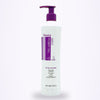
Purple shampoo cleans your hair and leaves violet dye behind. Fanola says its No Yellow Shampoo "neutralizes unwanted yellow reflections" and is "For blonde, bleached, highlighted, grey hair". It does not change how light the hair is; this site's 350ml listing positions it for keeping blonde and grey hair fresh "between salon visits".
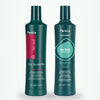
The violet in Fanola No Yellow Shampoo is Acid Violet 43, the only colourant in the shampoo ingredient list (INCI) printed on this store's No Yellow Shampoo & Mask Twin Pack 2 x 1000ml listing. The EU's Scientific Committee on Consumer Safety (SCCS, opinion SCCS/1491/12) describes it as a colour used in semi-permanent hair dye formulations and assessed it "as a non-oxidative hair dye". That fits Goldwell's education manual, which defines a direct dye as one that "deposits colored dye molecules directly without needing oxidation".
Goldwell describes semi-permanent colour as "generally absorbed on or near the surface of the hair", and says direct-dye stains have "limited durability on natural hair, longer on porous hair". In plain terms, it is a surface colour with limited staying power, which is why a toning shampoo is a routine product rather than a one-off fix.
Contact time matters. Fanola says the No Yellow Shampoo's "progressive-release anti-yellow pigment" gives "an increasingly intense neutralizing effect the longer it is left on". That is the manufacturer's own claim, without published test data, but it matches this site's 350ml listing, which says to leave it on longer "for clients needing a more intense tone". The violet pigment inside a No Yellow formula is the next layer down.
How does purple shampoo work?
Purple shampoo works by adding violet to hair that is showing yellow. Goldwell's manual lists the opposite pairs: "Blue is opposite orange. Yellow is opposite violet. Blue-violet is opposite yellow-orange. Red is opposite green." Its instruction is just as plain: "To control yellow add violet." Wella's shade chart states the same rule: "Opposite colours neutralise one another." Schwarzkopf says its IGORA tone directions are used "to either neutralize underlying pigments or to enhance a desired tone".
Goldwell prints the outcome as a plain equation: violet plus yellow equals brown. Toning adds a second colour to the first; nothing is taken out.
The yellow does not go anywhere. On Goldwell's law of colour, violet is added to yellow; the yellow is not removed. Lightening is the step that removes pigment, and Goldwell defines lift as "the lightening of natural pigments with hair color or bleach". A shampoo with no peroxide in it does neither.
Who should use purple shampoo?
Fanola aims No Yellow Shampoo at blonde, bleached, highlighted and grey hair. The level of the hair decides whether yellow is the tone you are actually looking at. Wella's lightening curve labels the underlying pigment at each depth: 10/ very pale yellow, 9/ pale yellow, 8/ yellow, 7/ orange/yellow, 6/ orange. Goldwell's stages of lift name them differently but follow the same pattern: yellow is only "possible" at level 10, with gold below it and orange from level 7 down. Schwarzkopf's IGORA VIBRANCE chart lists "pastel toning on level 9 & lighter" among the uses of its Pastel shades: a professional colour, not a shampoo, but aimed at the same light levels.
The second group is grey and white hair with a yellow cast. A 2014 study (Richena and colleagues, Journal of Photochemistry and Photobiology B) notes that yellowing "is common in people with white and grey hair". In the lab, heating cut grey hair to 81 °C yellowed its white fibres, while visible and infrared light bleached it. The authors wrote that the origin of yellowing "is not properly established". Fanola lists grey hair among No Yellow Shampoo's intended uses.
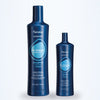
The third is anyone keeping a salon colour fresh between appointments, which is how this site's listings describe its job. Fanola No Yellow Shampoo 350ml is £6.73 at the time of writing, about £1.92 per 100ml. The 1000ml is listed at £12.00, which works out at £1.20 per 100ml.

Violet, blue or green: which toning shampoo does your hair need?
The neutraliser is the colour opposite the tone you are fighting, and that tone changes with how light the hair is. Blue sits opposite orange, so orange is corrected with blue rather than violet. Goldwell's glossary draws it finer still: a drabber uses "ash-blue for unwanted orange tones, pearl (blue-violet) for unwanted gold (yellow-orange), violet for unwanted yellow".
| Fanola shampoo | Pigment | Neutralises | Who the listings are aimed at |
|---|---|---|---|
| Fanola No Yellow Shampoo | Violet: Acid Violet 43 in the printed INCI | Yellow | Blonde, bleached, highlighted and grey hair |
| Fanola Wonder No Orange Shampoo | "Infused with blue pigments", per this site's 1000ml listing | Orange and copper (1000ml listing); the 350ml listing says orange | Light brown to dark blonde hair (1000ml listing) |
| Fanola No Red Shampoo | Sold as "rich in green pigments"; the 350ml INCI names four dyes, none of them green | Red tones | Brunette, brown and chestnut hair with unwanted red tones |
Some neutralisers list a single dye, as the No Yellow Shampoo INCI on our twin-pack listing does with Acid Violet 43. Others list several: our No Red Shampoo 350ml listing names HC Blue No. 15, Basic Brown 17, Basic Yellow 87 and Basic Red 76, and no green dye. So judge by the tone the product is listed to neutralise, not by the colour of the bottle. How blue pigment handles orange and neutralising red tones in brown hair cover the other two.

What can't purple shampoo do?
Purple shampoo cannot lighten hair, correct orange or red, turn brown hair blonde or replace a salon colour service. It adds violet and nothing else. In detail, it cannot:
- Lift, or change the level. The printed No Yellow Shampoo INCI contains no hydrogen peroxide and no persulfate. Even a professional toning colour with a 1.9% activator does not lift: in Schwarzkopf's IGORA VIBRANCE chart, the row for its 1.9% (6 vol) Activator gives "Level of lifts: None", and its listed uses include "Pastel Toning & Neutralization".
- Correct orange or red. Wrong complement. On Goldwell's wheel orange needs blue and red needs green. Fanola's No Red Shampoo, sold as "rich in green pigments", is the one listed for brunette, brown and chestnut hair with unwanted red tones.
- Turn brown hair blonde. That is lift, which Goldwell defines as "the lightening of natural pigments with hair color or bleach". A shampoo is neither.
- Replace a salon colour service. IGORA VIBRANCE, for example, is a professional colour mixed 1:1 with its own Activator. The shampoo is maintenance between those services.
How do you control how strong the result is?
Leave-on time is the dial. Fanola says a longer leave-on time gives a stronger neutralising effect. This site's 350ml No Yellow listing gives 3–5 minutes, and up to 10 "for clients needing a more intense tone", which is written as a salon instruction; the 2 x 1000ml twin pack says 1–5 minutes "depending on the desired toning effect", and Fanola's own No Yellow page says only "a few minutes". Our 1000ml listing adds that for damaged or dry hair, stylists should "use the shampoo sparingly to avoid over-processing". Follow your pack, and see how to use purple shampoo for technique.
Porosity decides where colour takes first. Goldwell defines grabbing as "the tendency of color to be absorbed more readily in porous or damaged areas of the hair". Bleaching causes that kind of damage: in a 2018 lab study, peroxide-persulphate bleach caused "substantial damage to the cuticle layers and to the cortex" (Grosvenor and colleagues, International Journal of Cosmetic Science). Older ends also carry more oxidative damage from weathering, rising from mid-length to tip (Signori and Lewis, 1997). This site's 350ml listing also says to "Focus on areas that are most affected by yellow tones".
Toning also comes in a mask format. The No Yellow Mask in the same twin pack also lists Acid Violet 43, and its directions put it on towel-dried hair after the shampoo for 3–5 minutes. When the mask beats the shampoo covers the trade-offs.
Strand test before a first use, and start at the short end of the time. Goldwell defines a strand test as "a testing method used to determine the processing time and color result".
Fanola's official directions for No Yellow Shampoo say "Wear appropriate gloves", and the No Red listings on this site say: "Remember to wear disposable gloves during application." The SCCS found Acid Violet 43 safe as a non-oxidative hair dye at up to 0.5% on the head, but added that "a sensitising potential cannot be excluded". So wear the gloves.
When is it a salon job?
A colourist is the right answer whenever the problem is level, not just a little yellow: orange on hair you want lighter, any change of level, or previously coloured hair that needs lightening. Lift needs hair colour or bleach, and bleach damages the fibre, as the Grosvenor study shows. Goldwell's procedure for lightening previously coloured hair says to "process until hair has lightened to one level lighter than your target color", because "this ensures accuracy and control when toning". Colour services carry their own precautions too: Wella's shade chart recommends "that an allergy alert test is done 48 hours before colouring".
Shampoo maintains tone; it does not change level. If you want lighter hair, or the warmth is orange or red rather than yellow, a violet shampoo is the wrong tool. Where any guidance here differs from the instructions supplied with your product, follow the pack.
Common questions
What happens if you use purple shampoo on brown hair?
It is not what it is made for. On Wella's lightening curve, 4/ (which Wella calls Medium Brown) exposes redish/brown, and the next depths up expose reddish/orange (5/) and orange (6/). Goldwell says that "in darker levels, orange will appear". Those tones need blue or, for red, green, which is what green shampoo for red tones covers.
My hair is orange, not yellow. Will purple shampoo fix it?
No. On the colourist's wheel violet is opposite yellow, not orange; orange is corrected with blue. On Goldwell's stages of lift, orange belongs to levels 7 and darker, while yellow appears only at the lightest levels. Getting from orange to yellow means more lift, which is a salon job; for keeping orange in check, see blue shampoo for orange tones.
Does purple shampoo actually clean your hair?
Yes. Our 100ml listing names "Gentle Cleansing Agents" that "Clean the hair without stripping". The No Yellow Shampoo ingredient list printed on our No Yellow Shampoo & Mask Twin Pack 2 x 1000ml listing starts "AQUA / WATER, SODIUM LAURETH SULFATE", so the 1000ml shampoo in that pack contains sodium laureth sulfate (SLES, not SLS), followed by sodium cocoamphoacetate (printed "SODIUM COCOAMPHOCETATE"), decyl glucoside and cocamidopropyl betaine. Our 350ml and 100ml listings print no full ingredient list. The 350ml listing suggests following with "a hydrating conditioner" or the No Yellow Mask.
How often should you use purple shampoo?
This site's 350ml listing says "For best results, use once a week". That is a recommendation, not a stated maximum; the twin pack says "once a week or as needed". How to use purple shampoo covers adjusting it, and No Yellow vs Wonder No Yellow compares the two violet shampoos.
How long does the toning last?
It is temporary. Goldwell gives direct-dye stains "limited durability on natural hair, longer on porous hair", and Fanola describes No Yellow as maintaining your blonde "wash after wash". The listings put it on a weekly routine rather than a single use.
The Fanola toning range on this site
No Yellow Shampoo is listed in 100ml, 350ml and 1000ml, alongside No Yellow Mask in 100ml, 350ml and 1L, the Wonder No Yellow line, both the No Red and Wonder No Red lines, and Wonder No Orange.
Prices and sizes are as listed at the time of writing and can change. Always follow the instructions supplied with the product, strand-test before a first use, and if you are unsure about a colour service, speak to a professional colourist.
-
Posted in
Blonde, Colour theory, No Yellow, Purple shampoo, Toning