How to Use Purple Shampoo Properly (Without Ruining Your Blonde)

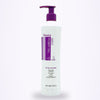
To use purple shampoo, apply it to wet hair, work it into a lather, focus it where the yellow is worst, leave it on for a timed few minutes, then rinse thoroughly and condition. For Fanola No Yellow Shampoo, the 350ml product page gives 3 to 5 minutes (up to 10 for a more intense tone) and recommends once a week for best results.
How do you use Fanola No Yellow Shampoo?
Apply it to wet hair and massage it gently into a lather, focusing on the areas most affected by yellow tones. Leave it 3 to 5 minutes, rinse thoroughly, repeat if necessary. Then, in the page's words, "Pair with a hydrating conditioner or Fanola's No Yellow Mask". For best results, use it once a week. That is the method on the 350ml product page.
How long do you leave Fanola No Yellow Shampoo on?
The 350ml page gives 3 to 5 minutes, and says that "for clients needing a more intense tone", you can extend it to up to 10 minutes. The 1000ml page gives 3 to 5 minutes. The 2 x 1000ml twin-pack page gives 1 to 5 minutes "depending on the desired toning effect". Timing matters because Fanola's own site says the shampoo "delivers an increasingly intense neutralizing effect the longer it is left on". Fanola gives no test data for this.
How often should you use Fanola No Yellow Shampoo?
Weekly is the default the pages give, though none of them sets it as a maximum. The 350ml page says "For best results, use once a week", and elsewhere "Use weekly" for clients with coloured or bleached hair. The 100ml page says "Use once a week" in its directions, but its specifications say "Designed for weekly use or as needed for colour maintenance". The 1000ml page describes the shampoo as "a weekly maintenance step" for a silver or ashy blonde look. The twin-pack's "Use once a week or as needed" comes after the mask step, so it covers the shampoo-and-mask routine together. Fanola.it's professional tip: "Alternate its use with Wonder Nourishing Shampoo".
Why a habit, not a one-off? Fanola.it describes the result as "gradual and adjustable, helping you maintain your perfect blonde wash after wash". The Wonder No Yellow Shampoo 1000ml page calls its toning action a "Temporary solution; use regularly to maintain cool tones between salon visits".
What do you need before you start?
The shampoo and a pair of gloves. Fanola's directions on fanola.it begin "Wear appropriate gloves". The only listing on this site that prints the shampoo's ingredients is the No Yellow Shampoo 1000ml + Mask 1L twin pack. There, the shampoo's INCI includes Acid Violet 43 (printed as "ACID VOILET 43"), and it lists no hydrogen peroxide and no persulfate. It makes no explicit "peroxide-free" claim. None of the directions involves mixing it with a developer: it goes straight onto wet hair. Whether purple shampoo can lighten hair, and how the violet works, is covered in how purple shampoo actually works.
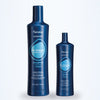
Don't confuse it with the Fanola No Yellow Color Toner, which is a different product with its own listing. That listing calls the toner "Professional strength" and says it was "developed with both professionals and hair enthusiasts in mind". Fanola No Yellow Shampoo 350ml is £6.73 at the time of writing. The shampoo is also listed in 100ml and 1000ml sizes.

Try a strand test before the first full application. Goldwell's colour manual defines a strand test as "a testing method used to determine the processing time and color result", "usually done on a strand from the top hair" because that hair is the most damaged. It also describes "grabbing": "the tendency of color to be absorbed more readily in porous or damaged areas of the hair". Goldwell means salon colour in general, not purple shampoo. Follow any instructions on the pack.
How do you use purple shampoo, step by step?
Wet, lather, time, rinse, condition. Each step comes from Fanola's own directions.
- Wet the hair thoroughly first. The 100ml page's first step is "Wet the hair thoroughly to prepare for application".
- Spread it evenly, then focus on the yellow. The 100ml page says to apply "a generous amount ... ensuring even distribution". The 350ml and 1000ml pages say to focus on the areas with yellow tones. Goldwell's troubleshooting table gives "Color was applied to the ends too soon, causing an over-deposit on pre-existing porosity" as one possible reason for ends going too dark. That table covers colour in general, not purple shampoo, so it is a reason to watch porous ends, not a rule.
- Leave it on, and time it. 3 to 5 minutes on the 350ml, up to 10 for a more intense tone; 1 to 5 minutes on the twin pack. Set a timer.
- Rinse thoroughly. The 100ml page says "Ensure all product is rinsed out completely".
- Repeat only if you need to. The 350ml page says "Repeat if necessary for optimal toning results".
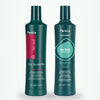
Then condition. The 350ml page pairs the shampoo with a hydrating conditioner or the Fanola No Yellow Mask 350ml. The 1000ml page says to follow it with "a nourishing conditioner or hair mask to restore moisture". When the mask is the better choice is covered in Fanola No Yellow Mask: when the mask beats the shampoo.
Where should the shampoo actually go?
Fanola's answer is simple: focus on the areas most affected by yellow tones. Lab research on bleached hair is a reason to also keep an eye on the lengths that have been lightened most, though none of it tested a purple shampoo on a head.
In a lab study of hair bleached with an alkaline peroxide-persulphate treatment (Grosvenor et al., International Journal of Cosmetic Science, 2018), bleaching turned cystine disulphide bonds into cysteic acid. The authors call this "untargeted oxidative damage across the fibre in addition to the desired loss of melanin". Protein loss "increased with bleaching severity". A second lab study (Tokunaga et al., Cosmetics, 2019) bleached hair four times. That removed 18-MEA, the fatty layer that makes the hair's surface water-repellent, and made the surface easier to wet. The hair still kept its water-repellence, though: bleaching alone "was not enough to cause a complete loss of hydrophobic nature".
On dye uptake, a 1987 Helene Curtis patent (US4678475) tested a violet conditioner containing Ext. D&C Violet No. 2 on hair tresses. It reported that unbleached tresses gave "much less deposition" than bleached ones. That is one in-vitro test of one formula, and it points towards bleached hair picking up more violet. Treat it as a reason to strand-test and watch your most-lightened lengths, not as a measured rule for your hair.

Wear gloves. Fanola's directions say "Wear appropriate gloves". The 1987 patent describes older violet shampoos whose dye "flows over the scalp", staining it; that is formulas of the time, not Fanola's.
What else changes the result?
Besides time and frequency, the 1000ml page mentions two things. Concentration: the 1000ml page says those with curly or coarse textures "may benefit from mixing it with a hydrating shampoo for gentler toning". That is a suggestion, and the page gives no mixing ratio. Condition of the hair: the same page says that for damaged or dry hair, "use the shampoo sparingly to avoid over-processing and pair it with a moisturising treatment".
If the result isn't what you wanted
Each result below is matched to what the sources say.
| What you see afterwards | What the sources say | What to do next |
|---|---|---|
| Uneven: some areas cooler than others | The 100ml page asks for "even distribution"; the Wonder No Yellow 350ml page asks for "even coverage throughout". | Next time, spread the lather evenly before focusing it on the yellow areas. |
| Ends darker or more violet than the rest | Goldwell lists colour reaching the ends too soon, on porous hair, as one possible cause of ends going too dark (colour in general). | Strand-test the ends, and shorten their contact time next wash. |
| Warmth that looks orange rather than yellow | Fanola's answer to orange is blue: its Wonder No Orange shampoo page describes a "blue pigment" that "neutralizes unwanted orange tones". | Read how blue pigment works on orange tones, or see the Wonder No Orange range. |
| Little or no visible change | Fanola says the effect gets more intense with longer contact; the 350ml page allows up to 10 minutes for a more intense tone. | Add time next wash, within your bottle's range (10 minutes at most on the 350ml). |
| Purple marks on your hands or scalp | Fanola's directions say to wear gloves; the 1987 patent records scalp staining from older violet formulas. | Wear gloves every time you use it. |
Two beliefs sit behind those rows. The first is "Purple fixes brass". Violet is for yellow; for orange, Fanola makes a separate blue product. Its Wonder No Orange page calls that shampoo "ideal for light brown, colored, or natural hair". The second belief is "leave it longer". The 350ml page does allow up to 10 minutes for "a more intense tone". But in its bleach-wash procedure, Goldwell's manual has stylists lighten until the hair is "one level lighter than your target color", because "this ensures accuracy and control when toning".
On safety and staying power: the EU Scientific Committee on Consumer Safety concluded that Acid Violet 43, as a non-oxidative hair dye at up to 0.5% on the head, "does not pose a risk to the health of the consumer", adding that "a sensitising potential cannot be excluded". The 1987 Helene Curtis patent said violet from the older shampoos it describes was "loosely bound" and washed away "within one or two washings". That is a description of formulas from that time, not a test of Fanola's.
What should you do after you rinse it out?
Condition, as the 350ml and 1000ml pages both say, then stick to the weekly rhythm. Know where a shampoo stops: Fanola presents No Yellow as maintenance: the 350ml page says it keeps clients' blonde or grey hair "vibrant and fresh between salon visits", and the 1000ml page says it is for use "between colour treatments".
Common questions
Do you use purple shampoo instead of your normal shampoo, or after it?
Fanola's directions treat it as the shampoo for that wash: wet the hair, apply it, lather, leave and rinse, with no other shampoo mentioned. On the twin-pack listing, the No Yellow Shampoo's INCI lists Sodium Laureth Sulfate (SLES) second, straight after water, and Sodium Lauryl Sulfate (SLS) does not appear. The standalone 100ml, 350ml and 1000ml listings don't print an ingredient list.
Do you need gloves, and will Fanola No Yellow stain your hands?
Wear them: Fanola's directions say so, and a 1987 patent recorded scalp staining from older violet shampoos.
How much purple shampoo should you use?
Enough for even coverage. The 100ml page says "a generous amount ... ensuring even distribution". The Wonder No Yellow 1000ml page says "a small amount evenly across the hair". None of the listings we read gives a millilitre figure.
Is Wonder No Yellow used the same way?
Nearly. Every Wonder No Yellow Shampoo listing here (100ml, 350ml, 1000ml and the 2 x 350ml twin pack) gives 1 to 5 minutes. The 1000ml page says to use it 1 to 2 times a week, compared with the classic 350ml's 3 to 5 minutes once a week. Follow the page for the bottle you have. The differences are covered in Fanola No Yellow vs Wonder No Yellow.
Does it work on grey or white hair?
Fanola says so. The 350ml and 100ml pages name grey hair alongside blonde and bleached, and fanola.it lists "blonde, bleached, highlighted, grey hair". The 350ml page says it "works on both natural and colour-treated hair". Strand-test first.
Is the No Yellow mask used the same way as the shampoo?
No. The Fanola No Yellow Mask page says: "After shampooing, apply the mask evenly on damp hair, leave it for 3-5 minutes, and then rinse thoroughly." On the twin-pack listing, both the mask's and the shampoo's ingredient lists include Acid Violet 43, so strand-test the mask as well. Its listing says it "nourishes and conditions hair".
The No Yellow range on this site
Prices quoted above are correct at the time of writing and do change.
Fanola No Yellow Shampoo 350ml, £6.73 →
Browse the whole No Yellow care range →
Next in this series: what is No Yellow shampoo? The violet pigment explained →
Always follow the instructions supplied with the product. Strand-test before a first full application, and if you are unsure about a colour service, speak to a professional colourist.
-
Posted in
Blonde, How to, No Yellow, Purple shampoo, Using it properly