Hot Roots and Orange Roots: Why They Happen and What Fixes Them

Hot roots are a root area that has come out warmer and brighter than the rest of your hair. Orange roots are hair that stopped in the orange stage of lightening. They need different fixes, and purple shampoo is the right answer for neither: hot roots need depth putting back at the root, while orange roots need more lift and then a blue-based toner.
How to fix orange roots and hot roots
Start by working out which one you have, because the fixes point in opposite directions. Hold a section against the mid-lengths in daylight. If the root is lighter and warmer than the rest, that is hot roots. If it is a solid orange or orange-gold band that looks under-done rather than over-done, the lightener stopped short.
Next, swap your purple shampoo for blue. Violet sits opposite yellow on the colour wheel; blue sits opposite orange. That is why we make a dedicated blue range, and our guide to how blue pigment neutralises orange tones explains the colour theory. Violet on genuinely orange hair pushes the result towards brown rather than blonde.
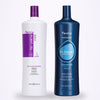
If the root band is warm but already light enough to read as a pale blonde, a blue-pigmented wash will cool it beautifully. Our Fanola Wonder No Orange Shampoo 350ml is made for light brown through to dark blonde hair and works through blue pigment. Leave it on for 1–5 minutes, once or twice a week. It deposits cool pigment over the warmth; it doesn't lighten.

If the band is at a different level rather than just a different tone, that is a colour service rather than a toning job. A colourist can put depth back into hot roots with a colour, or take an under-lifted root further up with a lightener. They are two different services, so get the diagnosis first.
Pro tip: bleach is not the fix for bleach. Re-lightening the same root on the same day is how hair snaps. Orange means under-lifted or under-toned, so the answer is a tone on top or a professional assessment, never a second round of home bleach.
Why hot roots happen in the first place
Two ordinary things make the root behave differently from the rest of the head. The first is heat: the scalp is warm, and that warmth lifts the root faster than the same product lifts the mid-lengths. The second is history. Your regrowth is virgin hair at its natural level, while the lengths start somewhere else entirely. One product, two starting points, two results.
With a permanent colour, the developer has plenty to lift at the root and little further down, so the root races ahead and reveals the warmth underneath while the lengths mostly deposit. With a lightener, the same gap can leave the root in the orange stage if it was kept clear of the scalp. This is the standard professional explanation for roots, mid-lengths and ends finishing at different levels. Always follow the instructions supplied with your pack.
Orange is a stage, not an accident. As hair lightens it travels through red, red-orange, orange, orange-yellow, then yellow. That is why an under-lifted root lands so reliably in the copper family.
| What happened | What you see | What fixes it | Where toning care fits |
|---|---|---|---|
| Hot roots after a permanent colour | Root band lighter, redder or brighter than the mid-lengths | Depth put back at the root with colour, not lightener | Colour first: toning doesn't change a level |
| Under-lifted roots after bleach or highlights | Solid orange or orange-gold band at the root from day one | More lift at the root, then a blue-based toner | Blue, never violet, once the root is lifted |
| Grown-out regrowth at its natural level | Darker new growth, warm where it meets lightened hair | A booked root retouch: a timing question | Retouch first: toning works on lightened hair |
| Toner faded from a root lifted far enough | Warmth returning gradually over weeks | Re-tone at the backwash, blue washing between | This is exactly its job |
How long does it take to put right?
A blue toning wash changes how the band reads in one use, then gradually washes back out over the next few. Toning shampoos and masks are direct dyes with no developer behind them: they sit on and just under the cuticle and leave with your normal shampoo. That makes them easy to adjust from one wash to the next.
A full correction runs on a different clock. It depends on how many levels apart root and lengths are, how porous the hair is, and how much it can safely take in one sitting. Large corrections are routinely split across more than one appointment, so ask your colourist for the plan up front.
You can only tone what you have lifted. Professional toners carry a minimum starting level, and a toning shampoo works with the level you already have. If the root still sits at orange, blue pigment keeps it looking cooler while you plan the lift.
How to stop it happening next time
Keep the retouch off hair that has already been lightened. Overlapping fresh product onto processed mid-lengths is what creates the level gap, and what damages the overlap band.
Diagnose by level before anything is toned. On a dark base, a blue-pigmented lightener is built for exactly this: our Fanola No Yellow Color Blue Lightener 450g is made for dark bases at levels 3 to 5, with blue pigment in the powder to counteract orange as the hair lifts.
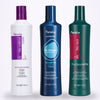
Between appointments, a blue-pigmented shampoo or toning mask holds warmth back. Choose by placement: the Fanola Wonder No Orange Mask goes on the lengths and ends, while the shampoo goes on with the wash. Our Fanola No Orange mask guide covers the mask in detail, and Fanola No Orange vs Wonder No Orange compares the two lines. If your warmth is whole-head rather than a root band, read our guide on how to get rid of brassy hair.
When to see a colourist
Book a colourist if root and lengths are more than a level or two apart, if you want more than a couple of levels of lift, if the hair is compromised, or if there is henna or old box dye in the history. Never bleach over henna or metallic dyes, and never over recent box dye without an assessment: uneven porosity is how patchiness, banding and hot roots start.
If the root reads red rather than orange, that calls for green; see green lightener vs green shampoo. Our lightening products are sold for trained use. Strand-test before any change of technique and wear gloves with strongly pigmented products. Our Fanola toners are oxidative, so carry out the allergy alert test set out in the pack leaflet.

Common questions about hot roots and orange roots
Why did my roots and hairline grab more than my ends?
Oxidative damage increases from the mid-point to the tip, so the ends are the most porous part of the hair: they take pigment up hardest and let it go fastest. The hairline is a stylist's watch-point for a different reason. It is the classic place for pigment to grab quickly, which is about contact time rather than porosity, so shorten the time there.
Why does my hair go orange again every two weeks?
Because the warmth was covered rather than removed. A toner is a deposit sitting over the level the hair actually is, and as it fades the true colour underneath returns. If that return is fast and orange rather than yellow, the hair needs more lift before toning.
Why does high-lift tint go orange on me?
High-lift colour carries a limited amount of lift, and darker natural hair has more warm pigment to travel through. On a dark base, the tint can run out of lifting power while the hair is still in the orange stage. That is where a blue-pigmented lightener earns its place.
Does my hair have to be lifted lighter before toning will hold?
Yes. Professional cool and pastel toners specify a minimum starting level, and a toning shampoo has no developer, so it works with the level you already have. Lift first, then tone.
Toning care for warm roots
Keeping orange in check is easy maintenance with the right blue.
Fanola Wonder No Orange Shampoo 350ml →
Fanola Wonder No Orange Mask 350ml →
Wonder No Orange Shampoo + Mask 1000ml →
Always follow the instructions supplied with the product. Carry out the allergy alert test in the pack leaflet for oxidative colour and toners, strand-test before a first use, and speak to a professional colourist about any colour correction.
Shop the range: browse our lightening range and our Wonder No Orange range.