Green Bleach for Hair vs Green Shampoo: Which One Lifts Colour?

Green bleach for hair is a lightener: a bleaching powder, tinted green, that is mixed with developer and makes the hair lighter. Fanola No Yellow Color Green Lightener is ours. A green shampoo such as our No Red deposits green-toned dye to cool red tones, and leaves the depth of the hair as it is. One lifts; the other tones.
So the question to ask is: is my hair the wrong depth, or the wrong tone? Too dark means lightening, a chemical service. The right depth with a red cast means toning, which our guide to green shampoo for red tones in brown hair covers in full.
Green lightener vs green shampoo at a glance
| Product | What it does | Mixed with | Starting point |
|---|---|---|---|
| No Yellow Color Green Lightener 450g | Lightens the hair "up to 5 levels", with green pigment to neutralise red tones during the lift | 1:2 "with all Fanola oxygens and with Violet Peroxyde up to 30 vol" | Natural hair, dark bases (level 4/6) |
| No Red Shampoo | Deposits green-toned dye to cool red reflects; no lift | Nothing. Used straight from the bottle | Brown and chestnut hair, natural or coloured |
| No Yellow Color Violet Lightener 450g | Lightens the hair "up to 7 levels", with violet pigment aimed at yellow | 1:2 with our developer, 10, 20 or 30 vol | Medium bases (level 5–7) |
The violet row answers the "green or violet?" question: we match our lighteners to the starting level, green for darker bases and Violet Lightener for medium ones. The rest of the family is in our guide to the No Yellow professional line.
What is green bleach for hair?
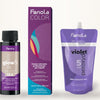
It is a lightening powder with a green pigment built in. Fanola No Yellow Color Green Lightener 450g is our ammonia-free green bleaching powder for natural hair on dark bases (level 4/6). It gives "up to 5 levels of lightening", with a green pigment "to neutralize red tones during the lightening process".

"Level 4/6" refers to the hairdressing depth scale, from 1 (black) to 10 (lightest blonde). That places it at the brown middle of the scale rather than on black hair. "Up to 5 levels" is the maximum lift.
How to mix it
"Mix 1:2 with all Fanola oxygens and with Violet Peroxyde up to 30 vol." "Oxygen" is our word for developer, the hydrogen peroxide cream. 1:2 means one part powder to two parts developer, weighed on scales.
Follow the instructions in the pack for processing. Lightening is judged by watching the hair as it develops, not by the clock alone, which is a large part of why it is a salon service.
How is lightening different from toning?
Lightening removes colour from inside the hair; toning adds colour on top. A salon lightening powder pairs oxidising salts with hydrogen peroxide and an alkaliser, and the mixed product is alkaline, around pH 10 in published examples. That mixture oxidises melanin, the hair's natural pigment, and the change is permanent.
The same chemistry reaches the hair's protein: studies of lightened hair find cystine, the bond-forming part of keratin, converted to cysteic acid, with a measurable loss of strength. That is why developer strength and timing are a colourist's call.
A toning shampoo works the other way round. Its colour is a direct dye, made in advance, which deposits on and just under the hair surface without any oxidising agent. With no peroxide, it leaves the melanin untouched, and it fades gradually with washing. The hair looks cooler and can look very slightly deeper afterwards.
The quick test is the developer, not the colour. A bleaching powder goes to work once it is mixed with peroxide, and what it lightens stays lightened. A toning shampoo is ready to use from the bottle, and it washes out. (Salon toners are mixed with developer too, but their job is to add tone, not to lift.)
Why put green pigment in a bleach?
Because dark hair turns warm as it lifts. Trade colour charts and hair-colour patents describe dark hair showing red-orange warmth when it is bleached, and one patent recommends "a bluish-green toner" for it. Green sits opposite red on the colour wheel, which is why our Green Lightener carries green pigment for dark bases.
Manufacturers' patents give several reasons for tinting a powder: to show the colourist where it has been applied, to make the end point easier to judge, and to counter a red cast while the hair lifts. Tinting dyes can wash out over later shampoos, so plan the finish: a toner or toning shampoo afterwards finishes the tone.
What does a green shampoo do?
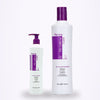
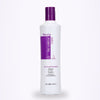
It tones brown hair that has gone red. Fanola No Red Shampoo 350ml is rich in green pigments for brown and chestnut hair, natural or coloured. Leave it on wet hair for 1 to 5 minutes, then lather and rinse, wearing disposable gloves.

Its green tone is a blend of HC Blue No. 15, Basic Brown 17, Basic Yellow 87 and Basic Red 76. Because it deposits rather than lifts, it is the finishing step, not the fix for uneven lift. If you have just bleached and the result is warm, see our guide to toning shampoo after bleaching.
Lightening dark hair is a salon job. Any bleaching powder mixed with peroxide is an alkaline, oxidising product, which is why our lightener instructions call for gloves at every stage. Hair that is coloured, previously henna'd or already damaged, or that needs more than a couple of levels of lift, belongs in a salon chair.
Follow the instructions in the lightener and developer packs, wear gloves throughout, and strand test first so you see how the hair responds before committing the whole head. With the green shampoo, wear disposable gloves too.
Can you use both?
Yes, and in a planned colour service that is usual. The lightener is used in the chair to reach the depth the target shade needs. A toner or toning shampoo follows, to perfect the tone and then hold it between visits.
If a salon toner is part of the plan, our explainer on our toners covers which one does what, and developer strength for toning covers which developer a toner is mixed with, a different job from lifting. Both our toners are oxidative colours, so do the allergy alert test described in the pack leaflet before the service.
Hair that has turned green from swimming or a faded fashion colour is a colour correction for a colourist to assess in person.
Which green do you need?
If the hair is too dark, you need lift. Our Green Lightener is a professional powder for dark bases, used with developer, scales and a colourist who can read the lift. For the salon, it also comes paired with developer: Green Lightener with Color Peroxide 1000ml, 20 vol.
If the depth is right and the tone has gone red, you need pigment. A green toning shampoo such as Wonder No Red Shampoo 350ml is the whole answer.
Common questions
Does green shampoo lighten hair?
No. A green shampoo contains direct dye in a cleansing base, with no peroxide, so it leaves the hair's natural pigment alone. It deposits colour that makes red tones read cooler, and the hair can look very slightly deeper afterwards. Lightening needs a lightener mixed with developer.
How long do you leave green lightener on?
Follow the instructions in the pack and check the lift as it develops. With lightening, the hair tells you when it is ready, so watch it rather than timing it blind.
Is green bleach gentler than ordinary bleach?
Our Green Lightener is ammonia-free and designed for gradual, even lightening. It is still a full lightening service, because lightening oxidises the hair's protein as well as its pigment, so give it the same care: strand test, gloves, and a colourist for anything major.
Green lightener or violet lightener?
We match them to the starting depth. The Green Lightener is for dark bases (level 4/6), for up to 5 levels of lift, and the Violet Lightener for medium bases (level 5–7), for up to 7 levels. Green is aimed at red warmth, violet at yellow.
Can I use a green lightener at home?
We recommend it as a salon product. Lightening dark hair means judging the level, choosing a developer strength and stopping at the right moment. If the hair is coloured, henna'd or damaged, or needs more than a couple of levels, book a colourist.
Always follow the instructions supplied with the product and its developer. Patch-test and strand-test where the manufacturer requires it, wear gloves with pigmented and lightening products, and speak to a professional colourist if you are unsure.
Shop the range: browse our lightening range.
-
Posted in
Colour theory, Comparison, Green shampoo and red tones, Lightening, Trade